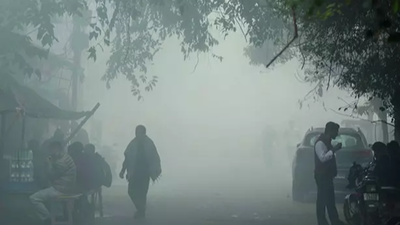
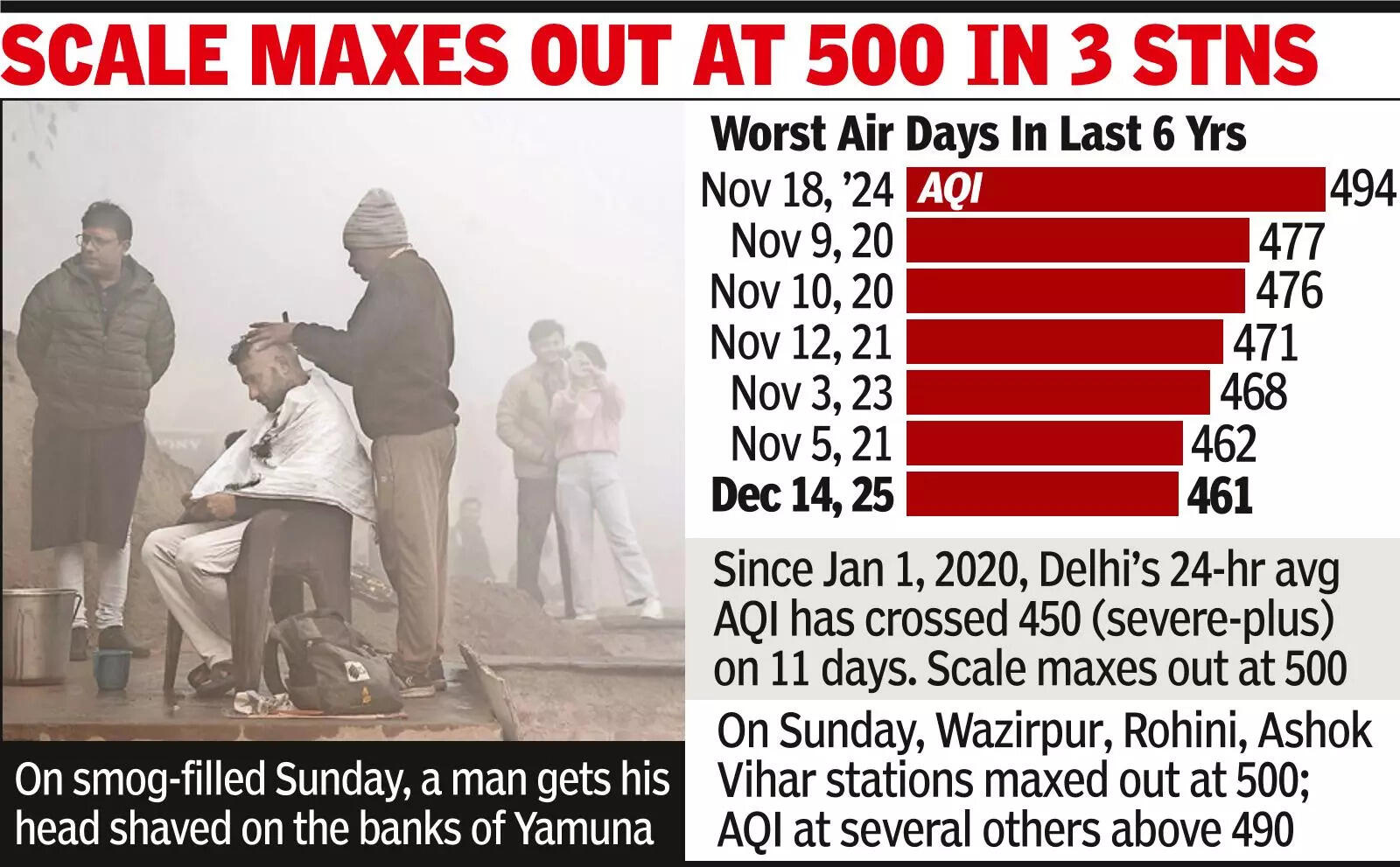
NEW DELHI: Delhi residents could see poison in the air on Sunday. A thick layer of toxic smog enveloped the capital, turning the city into a gas chamber with air quality plummeting to the “severe plus” category for the first time this year.The city’s 24-hour average air quality index was 461, the second worst in December and the worst in nearly 13 months. Since the scale began in April 2015, higher AQI has been recorded only once in December – 469, on December 21, 2017. The last time in a month that Delhi residents suffered the worst AQI was on November 18 last year (494).
AQI Severe-Plus, Delhi’s worst condition in more than a year
High humidity, low temperatures and calm winds effectively kept pollution close to the surface, even as gray smog obscured the sun for most of the day. Winds are forecast to increase slightly after midday on Monday, which could disperse some pollutants.On Sunday, the atmospheric “inversion” worsened the situation. This happens when cooler air near the ground becomes trapped beneath the warmer air above, preventing the spread of pollutants. Although meteorological conditions remained unfavorable for the dispersion of pollutants, local emissions remained high.“This is a true representation of Delhi’s local emissions as wind speeds are almost zero, meaning there is hardly any air flowing in or out. Vertical ventilation is limited to a column of just 600 meters, meaning whatever remains in the box Delhi is largely its own emissions. Under these conditions, the contribution of dust is negligible. As the winds are near calm, locations outside the immediate re-lease location cannot be polluted,” said Gufran Beig. Founder of the System of Air Quality and Weather Forecasting and Research (SA-FAR) and Chair at the National Institute of Advanced Studies (NIAS).Of the total 39 active air quality monitoring stations, 38 recorded ‘severe’ AQI while only Shadipur with 375 was placed in the ‘very poor’ category. Of these, three stations, Wazir Pur, Rohini and Ashok Vihar, touched a maximum of 500 while several others reported an AQI above 490.This is the second phase of heavy flying days in Delhi this season. The city had recorded three consecutive heavy days from November 11 to 13. This winter season, the city again recorded five such days where the AQI exceeded 400.After air quality began to deteriorate rapidly on Saturday, Level III of the Graded Response Action Plan was imposed in the morning. Stage IV was initiated on Saturday evening as the AQI showed no signs of improvement. All levels of GRAP are currently in effect.Delhi’s highest ever AQI was recorded at 497 on November 6, 2016. The second worst air quality day came on November 18 last year when the AQI reached 494.