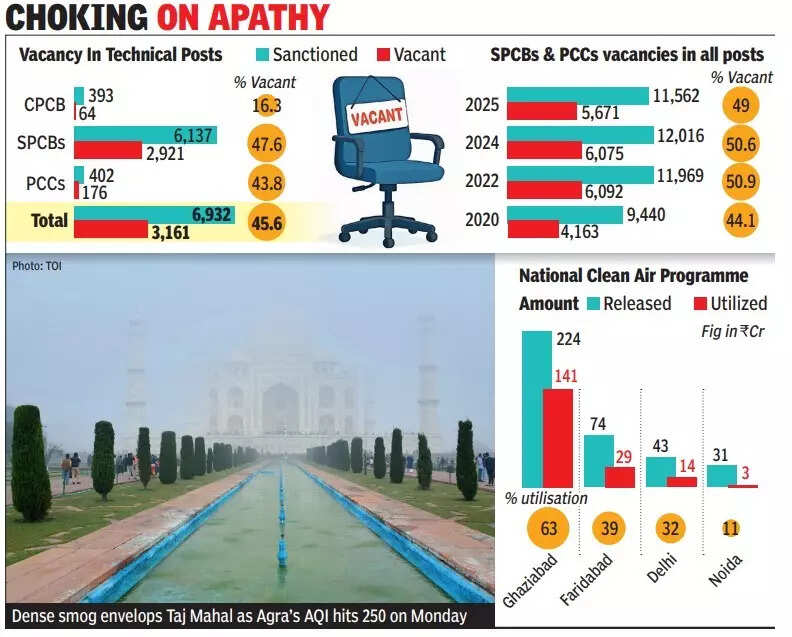
NEW DELHI: Almost half of the sanctioned positions in pollution control boards and committees across the country remain vacant even as most major cities are reeling from the impact of air pollution, says the reply to a recent question in Parliament.The answers to other questions this year show that this has been the case for the last five years. In addition, the use of funds under the National Clean Air Program was particularly poor in the capital and satellite cities.A question answered in the ongoing meeting revealed that apart from the Central Pollution Control Board (CPCB), there are 28 State Pollution Control Boards (SPCBs) and 8 Pollution Control Committees (PCCs) functioning in the UTs and NCT of Delhi. Overall, their sanctioned strength for scientific and technical posts is 6,932, of which 3,161 or 45.6% were vacant. In November, the vacancy rate was 16.3% in the CPCB, 43.8% in the PCC and 47.6% in the SPCB in August.
.
As with all posts, a response in March this year revealed that of the 11,562 sanctioned posts in the SPCBs and PCCs, 5,671 or over 49% were vacant. Vacancy rates have been between 44% and 51% over the last five years.According to the March response, 12 of the 28 SPCBs had vacancies above 50%. Sikkim topped the list with 100% vacancy, followed by Jharkhand and Andhra Pradesh, each of which had more than 70% staffing. Kerala was the only major state where the vacancy rate was less than 10%. In Goa, the vacancy rate was 9.3% while there were no vacancies in Arunachal Pradesh and Nagaland.Among PCCs, the vacancy rate was 44.5% in Delhi while it was 69% in Ladakh and Dadra & Nagar Haveli and Daman and Diu. There were no vacancies in Lakshadweep while only 11.1% of Chandigarh’s sanctioned strength was vacant. We have not yet received an answer from the Ministry of the Environment as to why there are so many vacancies. As soon as we do, the story will be updated online.Data from 44 urban agglomerations (UAs) shows that Noida, Delhi and Faridabad were at the bottom of the list in terms of utilization of funds under the National Clean Air Programme. A parliamentary question answered in March revealed that of the Rs 42 million released to the national capital, only 32% was utilized. The share was 11.1% for Noida and 39% for Faridabad. In comparison, Surat utilized all allocated funds and Chennai utilized 99% while Kolkata utilized 87%.