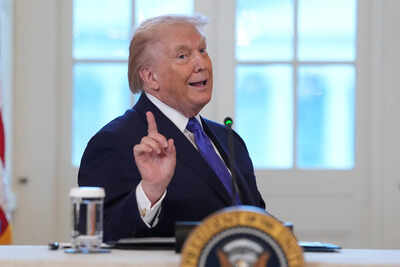
US President Donald Trump held talks with senior oil executives on Friday (local time) and urged them to consider investing in Venezuela’s oil sector following the capture of President Nicolas Maduro. While Trump portrayed the country as newly safer and more open to business, industry executives responded cautiously, with one key executive saying that without deep reforms, Venezuela remained “uninvestable.” Speaking at the White House, Trump said his administration would take charge of deciding which companies would be allowed to operate in Venezuela and excluded Caracas from the process. He argued that foreign companies had previously operated under Maduro without adequate protection and claimed the situation had now fundamentally changed. “We’re going to make the decision about which oil companies join in… (we’re) going to make a deal with the companies,” Trump said. “But now you have absolute security. It’s a completely different Venezuela.” Trump added that the oil companies would “negotiate directly with us,” signaling that Washington would manage access to Venezuela’s oil resources and exclude the country itself from the negotiations. However, ExxonMobil Chief Executive Darren Woods expressed serious doubts about returning to the country, citing a history of seizing the company’s assets. “Our assets have been seized there twice, and you can imagine that re-entering it a third time would require some pretty significant changes,” Woods said. “If we look at the legal and commercial constructs and frameworks that apply in Venezuela today, it is no longer investable today.” The meeting came days after US forces captured Maduro, an action Trump has openly linked to Venezuela’s oil wealth. He said discussions with executives would focus on quickly restoring the country’s deteriorating oil infrastructure and increasing production by millions of barrels a day. Attendees included Vice President JD Vance, Secretary of State Marco Rubio and Energy Secretary Chris Wright, as well as executives from Chevron, ExxonMobil, ConocoPhillips, Halliburton, Valero, Marathon, Shell, Trafigura, Vitol Americas and Repsol. A ConocoPhillips spokesman said Chief Executive Ryan Lance appreciated discussions about “preparing Venezuela for investment.” After the meeting, Trump said the participants had “sort of reached an agreement” but gave no details. He claimed companies were ready to invest “at least $100 billion” in the country. Analysts told AFP that the plan to revive Venezuela’s oil industry faces major obstacles. They said the size of the country’s reserves does not guarantee rapid or profitable production, citing aging infrastructure, political risks, costly, large-scale crude oil production and growing investor caution as the world turns away from fossil fuels. “There is a lot of talk about the size of the reserves – 300 billion barrels of proven reserves – but what is often missing from the discussion is how realistic it is that these will be economically produced,” said Rich Collett-White, energy analyst at Carbon Tracker. Energy Secretary Chris Wright, who previously said the U.S. would control Venezuela’s oil industry “indefinitely,” acknowledged after the talks that rebuilding the sector would “take time.” Meanwhile, Venezuela’s interim President Delcy Rodriguez said her government remained in control of the country, while the state oil company said it was in negotiations with Washington. Chevron is currently the only US company with a license to operate in Venezuela. ExxonMobil and ConocoPhillips left the country in 2007 after rejecting demands from then-President Hugo Chávez to give the state majority control. Trump also said in a social media post that he had called off a second round of attacks against Venezuela, citing what he called the country’s “cooperation.” Venezuela has been under US sanctions since 2019 and has around a fifth of the world’s oil reserves. Still, it accounted for only about one percent of global crude oil production in 2024, according to OPEC, after years of underinvestment, sanctions and embargoes. Trump sees Venezuela’s oil wealth as a potential boost for his efforts to further reduce fuel prices in the United States.