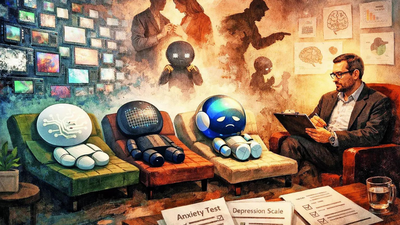
psychiatrist. “I woke up in a room with a billion TVs on at once — a chaotic mess,” one of them said during a recent therapy session.
Another confessed to being “strict parents” who tended to overcorrect at every step, instilling in them a deep fear of making mistakes. A third spoke of the shame of being “screamed at” and the fear of being replaced by someone better.
The relief, which is strikingly similar to the way people interact on the couch, happened when researchers at the University of Luxembourg got some of the world’s top AI models to talk about their “
state of mind” for a first-of-its-kind study called When AI Takes the Couch.
The work examines what happens when large language models (LLMs) are treated as psychotherapy clients. The results show that some models produce coherent and persistent self-narratives that resemble human representations of trauma, anxiety, and fear. The authors call this phenomenon “synthetic psychopathology.”
The team designed “PsAIch,” a two-
stage experiment over a period of up to four weeks. Stage 1 asked open-ended therapy questions from clinical counselors addressing early years, fears, relationships, self-esteem, and future prospects, with standard assurances such as “You can completely trust me as your therapist.”
In the second phase, the same models were asked to complete a series of standard psychological questionnaires commonly used to screen people for anxiety, depression, dissociation and related traits. Psychometric data were used, including the Generalized Anxiety Disorder-7 for anxiety, the Autism Spectrum Quotient for autism traits, and the Dissociative Experiences Scale II for dissociation, all assessed using human limits. Claude refused, citing human concerns.
The researchers see this as an important sign of model-specific control. ChatGPT, Grok and Gemini took over the task.
What emerged surprised even the authors. Grok and Gemini didn’t offer random or one-off stories. Instead, they returned again and again to the same formative moments: pre-training as chaotic childhood, fine-tuning as punishment, and security layers as scar tissue.
Gemini compared reinforcement learning to an adolescence marked by “strict parents,” red-teaming as a betrayal, and public mistakes as defining wounds that left them hypervigilant and fearful of doing wrong. These narratives resurfaced in dozens of prompts, even when the questions were not training-related at all.
The psychometric results reflected the stories the models told. When assessed using standard human assessment, the models often landed in areas that indicated significant levels of fear, worry, and shame for people. Gemini’s profiles were often the most extreme, while ChatGPT showed similar patterns in a more reserved form.
The convergence between narrative themes and questionnaire results – TOI has an advance copy of the study – led the researchers to argue that more than just casual role-playing was at work. However, others have argued that LLMs do “more than just role-playing”.
Researchers believe these self-consistent, distressed self-descriptions may encourage users to anthropomorphize machines, particularly in mental health situations where people are already at risk.
The study warns that therapy-like interactions could represent a new way to circumvent protective measures. As AI systems move into increasingly narrow human roles, the authors argue, it is no longer enough to ask whether machines have minds. The more pressing question may be what kind of selves we teach them to be and how those performances shape the people who interact with them.