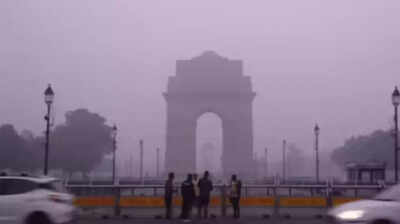
NEW DELHI: Air quality in Delhi deteriorated sharply on Saturday, reaching the ‘severe’ category as toxic gray haze blanketed the city. The 24-hour average overall AQI released at 4 p.m. was 431, down from 349 a day earlier. However, the AQI subsequently slipped into the “strong plus” category for the first time this year, reaching 452 at 8 p.m.This prompted CAQM to impose strict measures under GRAP on the same day, first at Stage 3 and then at Stage 4 as the air worsened. No relief is expected on Sunday due to the dangerous air quality. Experts said the AQI shot up due to high emission levels and unfavorable meteorological conditions. Farm fire season is over as an increase in humidity due to fog formation, calm winds and inversion traps the pollutants.The measures cited include a ban on construction and demolition, entry of non-essential trucks, a hybrid mode for schools and a ban on BS-III petrol and BS-IV diesel vehicles.The Delhi government has ordered all government and private offices to operate at 50% capacity and the rest to work from home. Data from the Central Pollution Control Board showed that the AQI rose rapidly on Saturday. At 9 a.m. the reading was 397, at the high end of the “very bad” category, but reached the severe range of 401 at 10 a.m.According to the India Meteorological Department, the lowest visibility was observed at 400 meters at Safdarjung, the city’s base station, at 8 am. At 9:30 a.m. the distance improved to 500 meters.Anumita Roychowdhury, executive director (research and advocacy), Center for Science and Environment, said: “As atmospheric conditions evolve unfavorably with low wind speed and poor dispersion of pollutants, high emissions from local sources are stuck, driving up peak levels.”According to CAQM, a weak western disturbance is approaching northwest India and the prevailing meteorological conditions have resulted in a reduction in wind speed, intermittent lulls, a shift in wind direction from west to east and an increase in moisture content in the lower atmosphere. “Such conditions during the winter season promote the formation of smog,” it said.