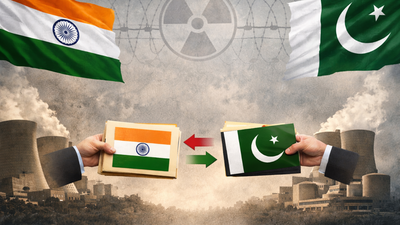
NEW DELHI: India and Pakistan on Thursday exchanged through diplomatic channels the list of nuclear installations and facilities covered under the Agreement on Prohibition of Attacks on Nuclear Installations and Facilities, the foreign ministry said.The exchange took place simultaneously in New Delhi and Islamabad and is in accordance with the terms of the bilateral agreement that governs the protection of nuclear infrastructure in both countries.
According to the MEA, the agreement requires India and Pakistan to inform each other on January 1 of each calendar year about the nuclear installations and installations covered by the agreement. Thursday’s exchange was the 35th consecutive exchange of such lists, the first taking place on January 1, 1992.The annual exchange has continued uninterrupted for over three decades, even during times of heightened political and military tensions between the two neighbors.
What is in the agreement
The Agreement on the Prohibition of Attacks on Nuclear Installations and Facilities was signed on December 31, 1988 and entered into force on January 27, 1991 after the exchange of instruments of ratification by both sides.Under the agreement, both India and Pakistan undertake not to take, promote or participate in any action intended to destroy or damage any nuclear installation or facility in the other country.The scope of the agreement is broad. Nuclear installations and facilities covered by the agreement include nuclear power plants, research reactors, fuel production plants, uranium enrichment plants, isotope separation plants, reprocessing plants and sites where significant quantities of radioactive material, whether fresh or irradiated, are stored.The agreement also requires both countries to exchange information about the locations of these facilities once a year, typically in the form of latitude and longitude coordinates.
Why annual replacement is important
The annual exchange of lists is intended to reduce the risk of accidental, miscalculated or deliberate attacks on sensitive nuclear infrastructure in times of conflict or crisis.By formally identifying protected areas, the agreement is intended to prevent conventional military operations from inadvertently escalating into a nuclear crisis. An attack on a nuclear facility, even with conventional weapons, could have catastrophic humanitarian, environmental and strategic consequences.Security analysts view the exchange as a confidence-building measure that helps maintain a minimum level of predictability between two nuclear-armed neighbors with a long history of conflict.Notably, the exchanges continued even during times of strained relations, including after major crises such as the Kargil conflict, the 2001-2002 military standoff, the 2016 Uri attack and the 2019 Pulwama attack, as well as airstrikes on Balakot.
Historical context
When the agreement was negotiated in the late 1980s, both India and Pakistan were steadily moving toward an open nuclear capability, although neither had yet conducted nuclear tests. Discussions focused on concerns about pre-emptive strikes on nuclear facilities, particularly in the context of regional instability.The agreement was one of the earliest formal nuclear confidence-building measures between the two countries and followed the 1998 nuclear tests, after which both openly declared themselves nuclear weapons states.Since its entry into force in 1991, the agreement has remained intact, although no progress has been made on broader nuclear arms control or risk reduction mechanisms in South Asia.
Limits of the agreement
While the pact prohibits attacks on nuclear facilities and installations, it does not restrict the development, deployment or use of nuclear weapons themselves. It also does not contain any verification mechanisms beyond the annual list exchange.The agreement also does not cover missile bases, command and control centers or other strategic military installations related to nuclear weapons.Still, diplomats and experts argue that continued compliance with the agreement reflects a shared awareness of the dangers posed by attacks on nuclear infrastructure.More than three decades after its entry into force, the agreement remains one of the few enduring pillars of nuclear risk reduction between India and Pakistan.In an environment characterized by limited dialogue and recurring tensions, the uninterrupted annual exchange of nuclear facility lists serves as a reminder that both sides continue to recognize the need to prevent catastrophic escalation.For now, the routine exchange remains a rare example of sustained institutional nuclear cooperation between the two countries.