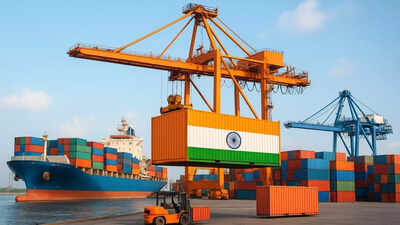
India’s target of exporting $1 trillion in goods and services by the end of FY26 is likely to remain out of reach, the Global Trade Research Initiative (GTRI) predicted in its latest report on Thursday, pointing to weak shipments of goods due to weak global demand and rising protectionist trends.Ajay Shrivastava, founder of the economic think tank, said India is expected to see a flat increase in exports this year and outflows of goods will see almost no growth. Total exports are only expected to rise to nearly $850 billion in FY26, missing the $1 trillion figure by $150 billion. The think tank forecast that services exports could cross $400 billion, providing “the only meaningful growth cushion for India’s trade” as overall growth struggles with weak global demand.
Meanwhile, Shrivastava stressed that the target can be achieved if India manages to conclude major trade deals. “I think we can achieve that once our trade deal with the US and the EU comes together. That’s maybe next year, not this year,” he said.While exports face continued pressure, Shrivastava said domestic economic conditions remained stable. “The domestic economy is doing well,” he said, adding: “The GDP numbers are meaningful; the low inflation numbers are meaningful. The only pressure on GDP will be the pressure on the export side.”
India’s trade with the US and EU – a different picture
Despite the overall slowdown, recent trade figures suggest that India has started to diversify its export destinations. Shrivastava noted that exports to the United States fell sharply between May and November, although shipments to other regions increased.Exports to the US fell nearly 21% as President Donald Trump imposed 50% tariffs on Indian shipments.“We saw that our exports to the US fell by 20.7% between May and November,” he said. The report added that “exports to India’s largest market risk further erosion unless Washington rolls back the additional 25% tariffs on India or strikes a trade deal.”For India’s trade with the European Union, the think tank pointed to a difference as exports fell even before tariffs came into play as the bloc’s compliance and reporting requirements reduced the country’s high shipments by almost 24%.The EU will “activate its Carbon Border Adjustment Mechanism (CBAM) on January 1, 2026, effectively imposing a CO2 tax on imports.” From next year, 2026, EU importers will mark Indian goods inclusive of CBAM costs, “with payments settled through certificate delivery in 2027.”
India is diversifying its export destinations
Shrivastava said, “During this period, our exports to the rest of the world have increased by 5.5%. This means diversification has already started to a small extent.”However, he warned that geographical diversification must be accompanied by changes in the composition of India’s exports. “For more diversification and for more exports to these countries, we also need to focus on diversifying our export basket,” Shrivastava said. “Right now, our export basket needs to include more medium to high-tech products.” The think tank said that while the country has already signed 18 free trade agreements and more could be added in 2026, India’s priority needs to change and move from signing deals to “translating free trade agreements into real export gains, particularly in electronics, engineering and textiles.”
What should India’s strategy be for 2026?
- For the next year, India’s export strategy needs to focus inward as its influence on global geopolitics is limited.
- Export growth will depend on improving product quality, improving the value chain and reducing production costs.
- Electronics, engineering and textiles will emerge as the biggest opportunities as higher value addition can support exports when the global trade environment is hostile.
- Use trade agreements effectively.
- Implementation of policies and programs should be the focus, with emphasis on operationalizing the export promotion mission, simplifying regulations and improving the ease of doing business.
The think tank warned that tariffs, climate-related taxes and geopolitical uncertainty will continue to weigh on global trading conditions. Export survival and growth will depend on domestic competitiveness, including better products, more comprehensive manufacturing capabilities and lower costs.In FY25, India’s total exports stood at $825 billion, including goods outflows of $438 billion and services of $387 billion.