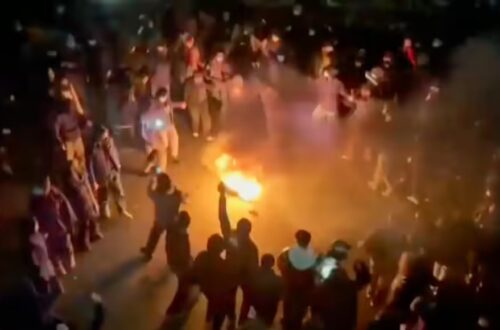
Iran has been rocked by widespread anti-government protests that have entered their second week. What began as demonstrations over the economic collapse have quickly expanded into broader calls for political change and the end of the country’s theocratic regime. Despite tight security measures, internet restrictions and mass arrests, protests have spread to several cities. As the unrest intensified, a familiar name from Iran’s past resurfaced in public debate: Reza Pahlavi, the exiled crown prince.In recent statements, Pahlavi urged protesters to stay on the streets, arguing that continued public pressure could lead to the collapse of the clerical regime. In a video message shared on social media, he told Iranians that their presence had “significantly weakened Khamenei’s repressive apparatus” and claimed that the authorities lacked loyal security forces. According to report by YEARSHe called on members of the military, police and state institutions to defect and warned them not to oppose the Iranian people “for the sake of a regime whose downfall has begun and is inevitable.”
Pahlavi stressed the opposition was prepared for a post-regime transition, saying there was a “100-day plan” to form a democratic government and prevent chaos. He urged more demonstrations and told protesters: “Don’t walk away from the streets. My heart is with you… We will take back Iran,” ANI reported.
Who is Reza Pahlavi?
Reza Pahlavi is the eldest son of Mohammad Reza Pahlavi, the last Shah of Iran who was overthrown during the 1979 revolution. He was born in Tehran in 1960 and was officially named crown prince in 1967 on the occasion of his father’s coronation his website, He left Iran in 1978 at age 17 for jet fighter training at Reese Air Force Base in Texas, just months before the revolution forced the royal family into exile.After completing his military training, Pahlavi pursued higher education in the United States, earning a degree in political science from the University of Southern California. After his father’s death in 1980, he declared himself exiled shah at a ceremony in Cairo, he later said The Washington Post in a 1989 interview: “In a way, I’m the king-elect.”Pahlavi, who has lived in exile in the United States for five decades, announced his plan to return to Iran in a video message and a recent post on X as demonstrations continued in Tehran and other cities. “I, too, am preparing to return to my homeland so that I can be by your side, the great nation of Iran, at the time of the victory of our national revolution. I believe that this day is very near,” he wrote.Pahlavi has lived primarily in the Washington, D.C. area and has advocated for political change in Iran. He has consistently stated that he does not seek a return to monarchy, but portrays himself as a champion of a secular, democratic system achieved through non-violent civil disobedience and a national referendum. In an interview with USA todayHe said he wanted to be a “catalyst” to help Iranians “achieve full democracy for the first time in their country’s history.”His influence remains controversial. While some analysts quoted from New York Post While others argue that growing nostalgia for the pre-revolutionary era has boosted his standing, others question whether he enjoys widespread support in Iran after decades in exile.