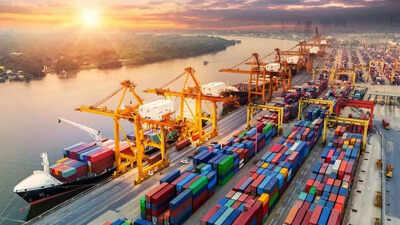
The year 2025 transformed global trade in ways not seen in decades, entering another uncertain period as pressures on growth and stability are expected to increase. So will 2026 be another turbulent phase for global trade?Global trade in goods remained stable through 2025 even as US President Donald Trump imposed higher tariffs that effectively raised barriers around the world’s largest economy. According to John McCown, a shipping industry veteran, global container volumes rose 2.1% in October compared to the same month last year, according to Bloomberg.Overall, however, the numbers showed strong regional differences. While inbound container volumes to the US fell 8%, imports to Africa, the Middle East, Latin America and India recorded strong growth, indicating a rebalancing of global trade flows.“Global container supply chains have already begun adjusting and reconfiguring trade patterns,” McCown wrote in a research note cited by Bloomberg. He compared the current slowdown to last year’s rally, noting that after U.S. container imports rose 15.2% in 2024, “to say that the annual total for 2025 will be in diametric contrast is an understatement.”McCown attributed much of this shift to Trump’s trade policies. In a LinkedIn post, he argued that the impact would be more clearly felt next year, with 2025 marking the peak of tariff announcements. He wrote that if 2025 is the year of tariffs, 2026 will be the year of tariff consequences.
2026 – The year of customs consequences
Trade analysts said several fault lines were already visible as 2026 approaches. One of the most closely watched developments will be the review of the United States-Mexico-Canada Agreement, the North American trade agreement that entered into force in 2020. The reassessment of the agreement is due just six years after its implementation, an unusually short time frame for such an agreement.U.S. Trade Representative Jamieson Greer told lawmakers this month that the process had generated great engagement, with more than 1,500 responses submitted as part of the public consultation. “Many stakeholders expressed support for the USMCA and many specifically called for an extension of the agreement,” Greer said, according to Bloomberg. “At the same time, virtually everyone involved also called for the agreement to be improved.” Any attempt to change the deal is likely to be controversial as profits for one member could come at the expense of another member. Industries in Canada and Mexico are already under pressure from U.S. import tariffs, while diplomatic relations remain strained. Tensions heightened in October after Trump broke off trade talks with Canada in response to anti-tariff advertisements with Ronald Reagan.At the same time, global shipping faces the prospect of new disruptions. Industry experts warn that two seemingly positive developments could strain supply chains.The first is a possible large-scale return of cargo ships to the Red Sea after shipping routes were rerouted around southern Africa for nearly two years due to Houthi attacks. As hostilities have eased since the Gaza peace plan came into effect in October, the route has become safer. French airlines CMA CGM SA and Denmark’s AP Moller-Maersk A/S have already resumed limited transits through the area.But a full return to the Red Sea and Suez Canal could overwhelm existing infrastructure. Lars Jensen, managing director of consultancy Vespucci Maritime, warned during a Flexport webinar in November that this would “flood the market with much more capacity” and lead to “massive problems with port congestion in Europe”.A second risk could arise from stronger demand. Jensen said if the U.S. economy accelerates in 2026, as Trump administration officials predicted, driven by lower interest rates and higher investment, a wave of restocking could exceed the shipping sector’s capacity.Uncertainty also exists regarding the durability of the Trump administration’s recent trade agreements. While the White House has pointed to agreements with several major economies in 2025, these agreements lack the enforcement mechanisms typical of traditional trade agreements. Most involve only short-term commitments, and the truce with China lasts only a year, leaving the US’s most imbalanced trade relationships unresolved.Fears that these agreements could fail have been heightened by recent events. Indonesia has resisted U.S. trade demands since Washington announced a so-called “landmark trade deal” in July, fearing curbs on its independence. A revised agreement is now expected at the end of January. China has objected to Malaysia and Cambodia over their trade deals with the US and warned against actions that undermine Beijing’s interests. According to Bloomberg, new complications also emerged in Great Britain.Greer said last week that difficult negotiations with the European Union and India would likely continue into the new year. His office also warned of possible retaliation against the EU and pointed to what Washington sees as excessive regulation of American technology companies.Adding to the uncertainty is a pending U.S. Supreme Court decision on the legality of Trump’s reciprocal tariffs, the sweeping tariffs imposed on most major trading partners. A ruling against the administration could raise questions about whether importers would be reimbursed for duties they have already paid.Kevin Hassett, director of the National Economic Council, told CBS’s Face the Nation that even in such a scenario, refunds are unlikely. It’s “pretty unlikely that they would ask for comprehensive refunds because it would be an administrative issue,” he said.Betting markets currently have about a 75 percent chance that Trump will lose the case, an outcome that could prompt the administration to rely on alternative legal powers to keep the tariffs in place.